Final Clipper
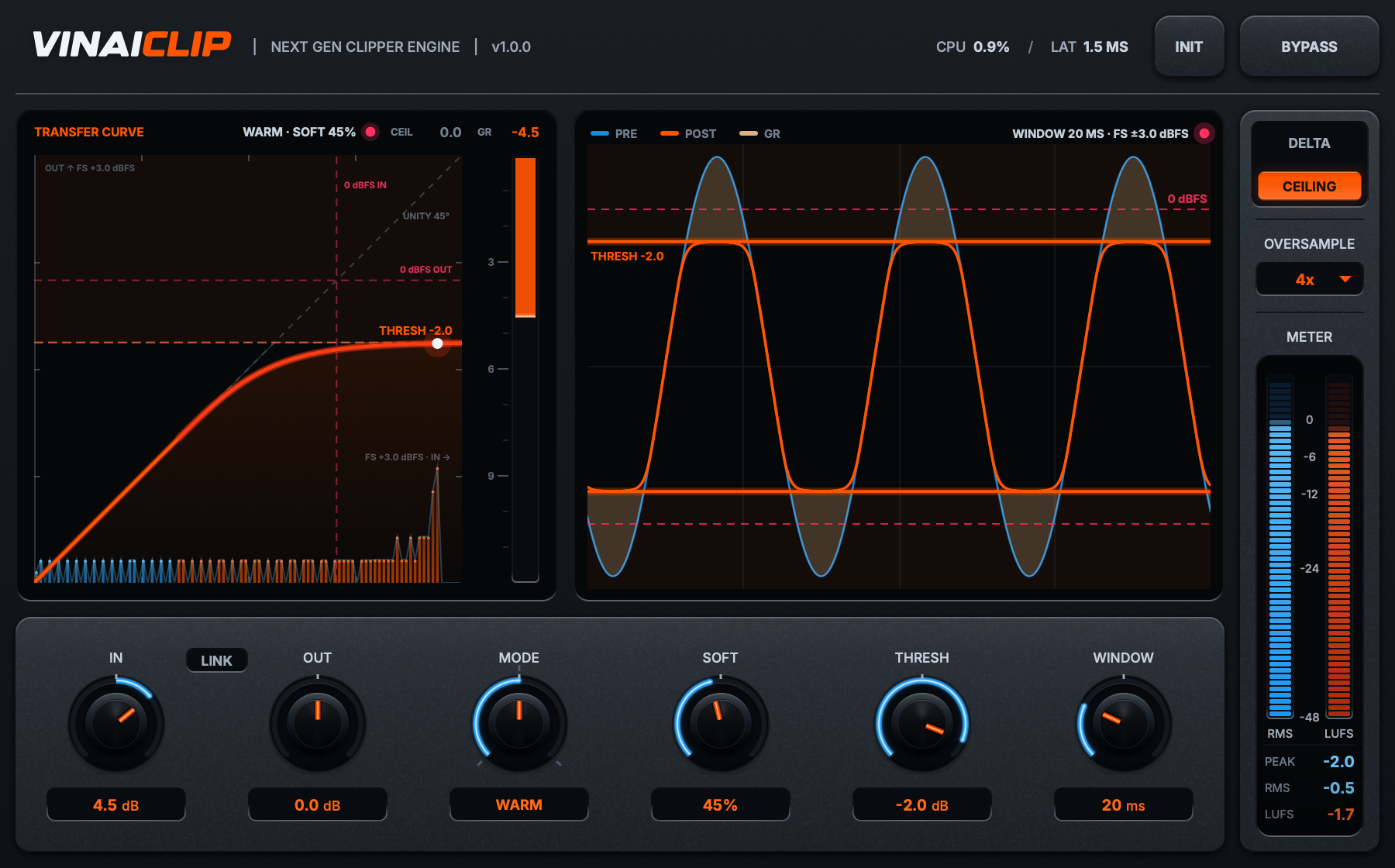
Transparent, surgical clipping for the last stage of the chain — with three distinct harmonic signatures. Hard, Warm and Tube, each with its own knee and harmonic colour, plus true-peak safety, oversampling up to 32× and Delta listen to hear exactly what you're shaving. Our Transparent Ceiling Engine — the ceiling you can trust.
VINAIclip touches amplitude only. The ceiling comes down with zero phase smear, so your transients and stereo image stay perfectly intact.
We ship numbers — measured to the floor of the instrument itself.
~1.3 ms latency · bit-exact bypass · anti-aliasing to −109 dBc @ default 8× OS · zero self-noise · 48 kHz

Pick the harmonic signature that fits the master. HARD is a brick-wall clamp with aggressive odd harmonics; WARM is the gentlest, most musical tanh kernel; TUBE adds even-harmonic, second-order warmth. The SOFTNESS control morphs the knee from a clean corner to a rounded curve across all three.
Each algorithm is a distinct clipping kernel with its own harmonic fingerprint — from a transparent brick wall to dense tube colour. Same threshold, same softness, three very different ceilings.
Brick-wall clamp — pure odd harmonics, aggressive and uncompromising. The transparent ceiling.
tanh kernel — dense odd harmonics, the gentlest and most musical of the three. Smooth glue.
Asymmetric tanh — even-harmonic, second-order tube warmth. Colour and weight, not just a ceiling.
A 0 dBFS sample peak can still overshoot once the converter reconstructs it. TRUE PEAK adds a 4×-oversampled inter-sample-peak safety clip that catches those overshoots before they reach the limiter on the other end. Push oversampling from 1× up to 32× to keep aliasing out of the harmonics you just generated.
Delta listen is the clipper's secret weapon: solo the clipped difference — only the harmonics and transients you're shaving off — and set your threshold by ear with total confidence, never guessing how hard you're hitting it. Alongside it, a LUFS / RMS meter and a pre / post / delta scope show exactly how much you're removing, and where.
| Type | Final-stage / mastering clipper |
| Algorithms | 3 — Hard · Warm · Tube |
| Softness | Knee 0–100%, all algorithms |
| Threshold | −24 dB to 0 dB |
| Gains | IN ±12 dB · OUT ±12 dB · Gain Link (mirror IN/OUT) |
| True Peak | 4×-oversampled inter-sample-peak safety clip (adds latency when on) |
| Oversampling | 1× / 2× / 4× / 8× / 16× / 32× (default 8×) — 32× export-only, live caps at 16× |
| Metering | LUFS / RMS meter · pre / post / delta scope · gain-reduction indicator · Delta listen |
| Phase | Transparent — phase fully preserved |
| Latency | ~1.3 ms @ 48 kHz at default 8× (scales with oversampling / true-peak) |
| Formats | VST3 · AU |
| Systems | macOS (Universal) · Windows · 64-bit |
| Engine | Native C++ · one-pole ~5 Hz DC blocker · time-aligned PDC bypass |
| Version | 1.1.0 |

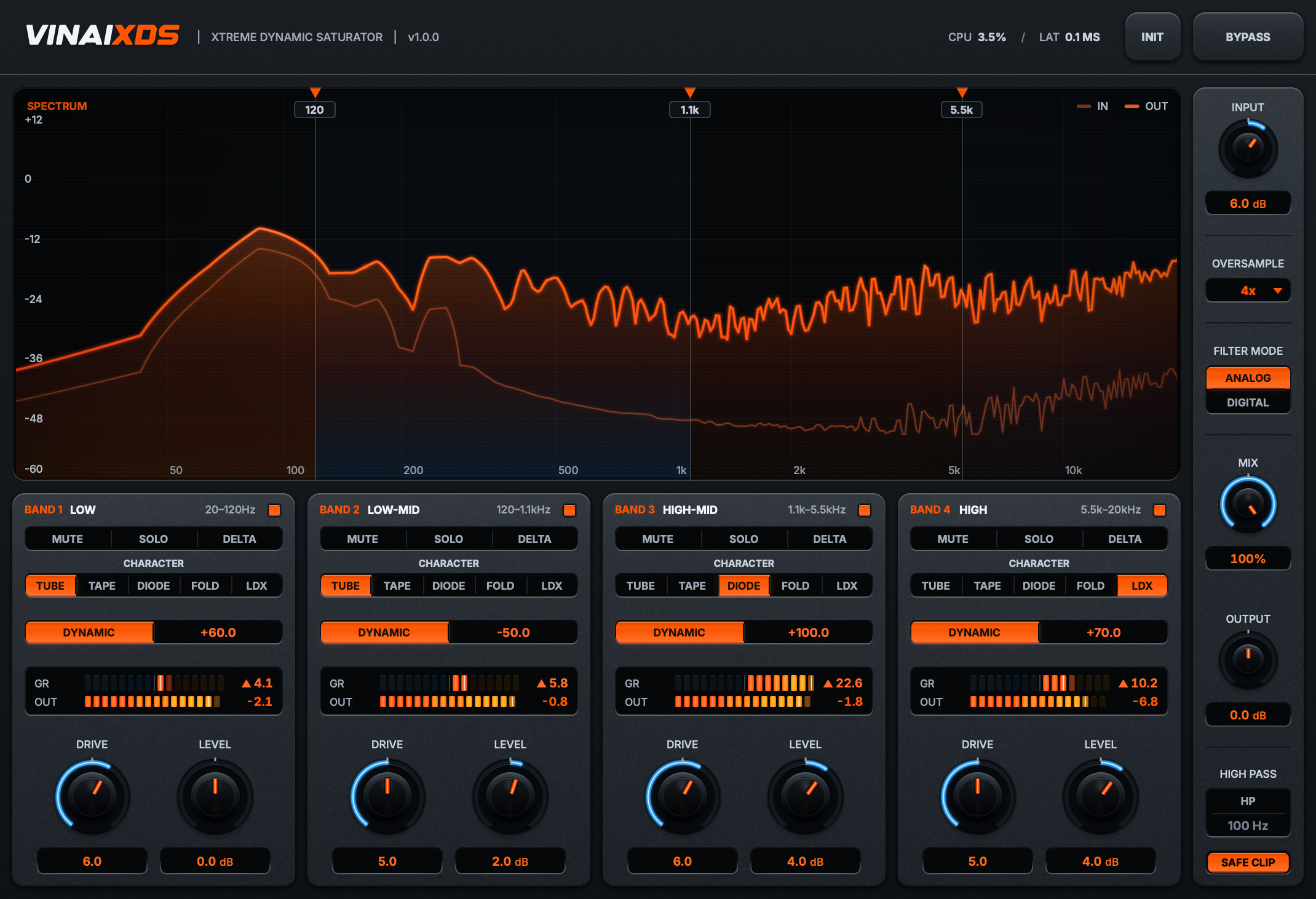
Generate the harmonics, then catch the peaks. Four bands, five distortion characters each, with a real-time analyzer.

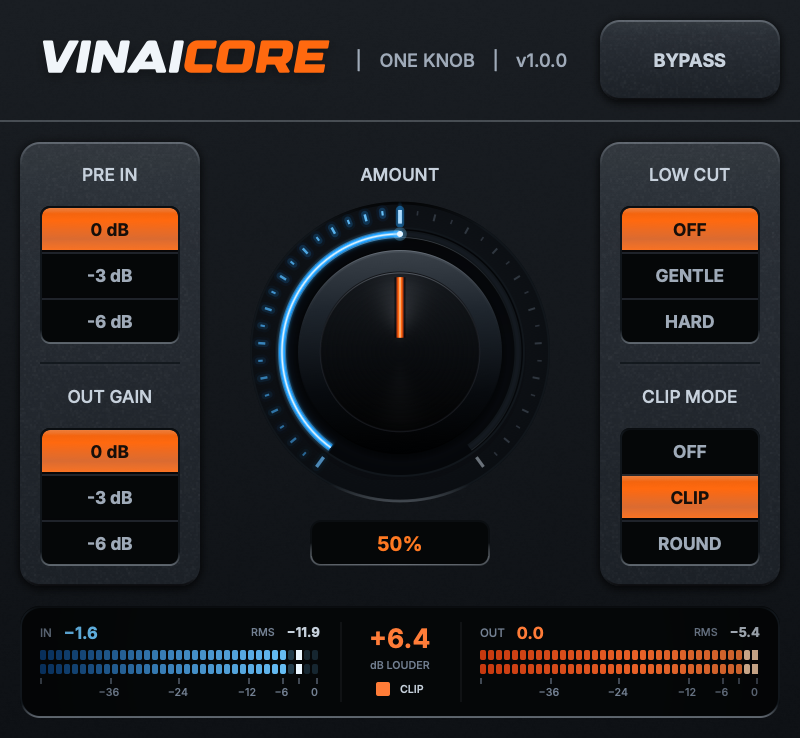
When you want loudness from a single control before the final clip. Saturation, dynamics and safety in one knob.

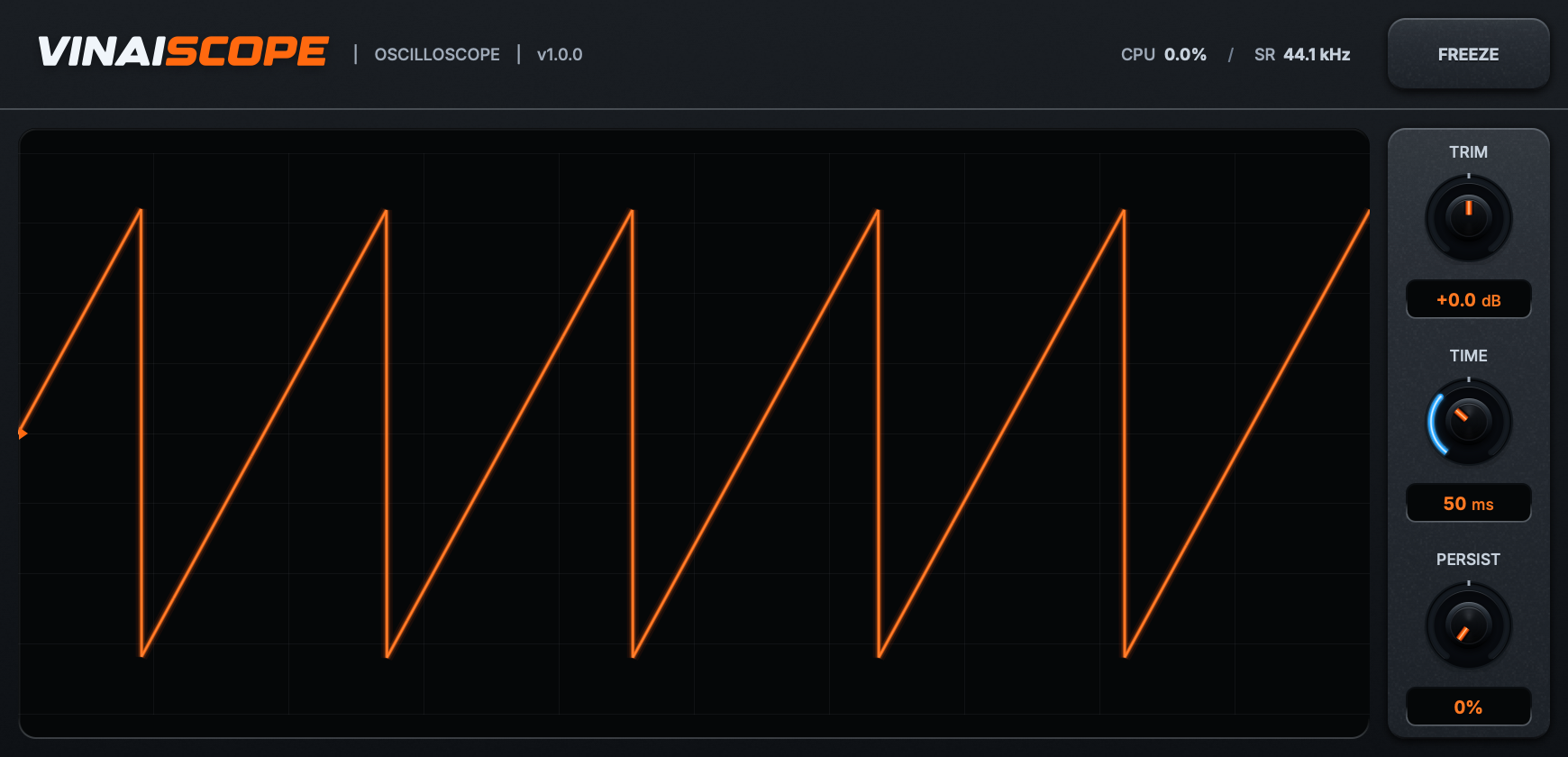
Watch the flat-topped waveform the clipper leaves behind — bit-transparent metering with phosphor persistence.