Stereo Widener
One widening move, done right. VINAIstereo runs the reference widener algorithm: a delayed copy of your signal, left side flipped, summed against the dry. Three controls, mono-safe by construction, and a lab-grade vectorscope that shows you the field you are building.
VINAIstereo widens the image without adding a single sample of latency. Bypass returns your signal bit-for-bit, exactly as it went in.
We ship numbers, measured to the floor of the instrument itself.
0 ms latency · bit-exact bypass · no measurable crosstalk · zero self-noise · 48 kHz

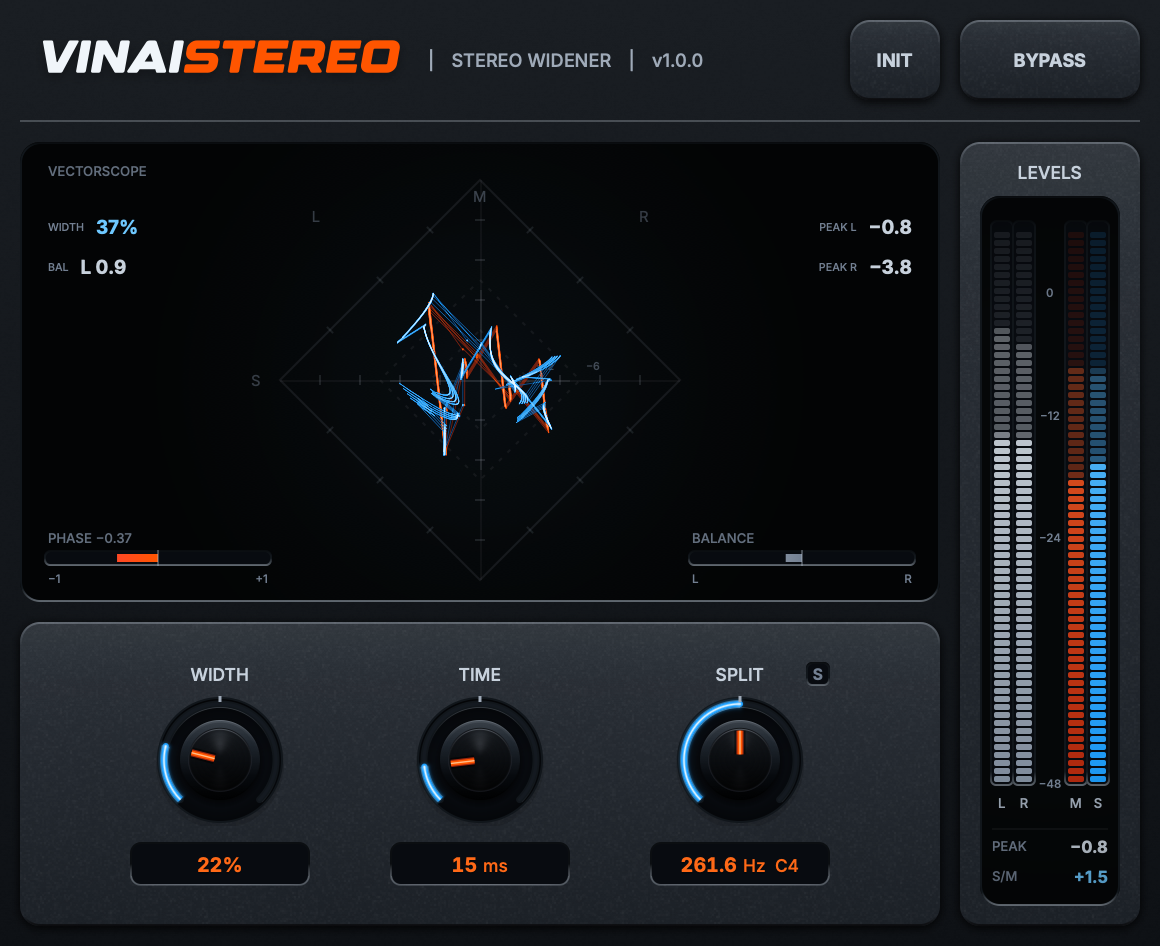
The widener that producers build by hand from a delay and a utility, engineered as one instrument. A copy of your signal is delayed by TIME (the same time on both channels), its left side is flipped, and the result is summed against the dry. WIDTH sets how much of it you hear; the dry is the centre you keep, and it never moves. On a mono source the wet cancels exactly in the mono fold-down: mono-safe is a property of the math, not a promise.
The display draws the last 38 ms of audio as a beam with real CRT physics: where the trace slows down the phosphor glows, where it sweeps it dims. The diamond graticule is digital full scale itself, so the edge always means something. The scale never zooms in: below 0 dBFS the figure is drawn 1:1, so size is level, and anything louder is pulled back to the edge one 10.7 ms slice at a time. There is no memory, so one loud peak never drags the next seconds down.
Along the bottom of the scope, a PHASE bar reads the correlation of what actually leaves the plugin, with the number beside it: blue toward +1, lava to red toward anti-phase. On the right, the LEVELS strip reads L and R next to MID and SIDE, the centre you keep and the width you are adding, with the side-to-mid ratio as one number. If MID drops while you open WIDTH, you are cancelling, not widening, and these meters are how you catch it.
Three controls build the field. The rest of the interface exists to prove, in real time, what those three controls are doing to your mix.
A delayed copy with the left side flipped, summed against the dry. TIME sets the character, WIDTH sets the amount, and the dry holds the centre.
A dwell-intensity vectorscope on a full-scale diamond graticule, drawn 1:1 below 0 dBFS and never zoomed in, with width, balance and peak readouts around the glass.
Widen the top, keep the bottom where it belongs. A 24 dB per octave high-pass sits on the wet leg only, so below the cut nothing is processed at all and the dry runs straight through. Snap it to the key of the track.
A PHASE bar for the correlation, plus L, R, MID and SIDE level columns: the mono-safety story of your output, told live.
| Type | Reference stereo widener for electronic music |
| Algorithm | Delayed copy, left polarity flip on the wet, summed against the dry · mono-safe by construction |
| Time | 1–100 ms in 1 ms steps, identical on both channels · 6-point fractional interpolation |
| Width | 0–100% in 1% steps · default 20% · moves the wet only, the dry stays at unity |
| Split | 20 Hz to 1 kHz high-pass on the wet leg only · 24 dB per octave, zero latency · OFF at the bottom of the travel, bit-exact · note snap to the nearest semitone |
| Vectorscope | 38 ms window · dwell-intensity beam (dry lava · output blue) · full-scale diamond graticule, 1:1 below 0 dBFS · −6 / −12 dB rings · WIDTH, BAL and PEAK L / R readouts |
| Metering | PHASE and BALANCE bars · L / R / MID / SIDE columns, RMS body and peak tip, −48 to +6 dBFS · PEAK and S/M readouts |
| Latency | Zero: 0 ms / 0 samples |
| Formats | VST3 · AU |
| Systems | macOS 12+ (Universal) · Windows 10+ · 64-bit |
| Version | 1.0.0 |

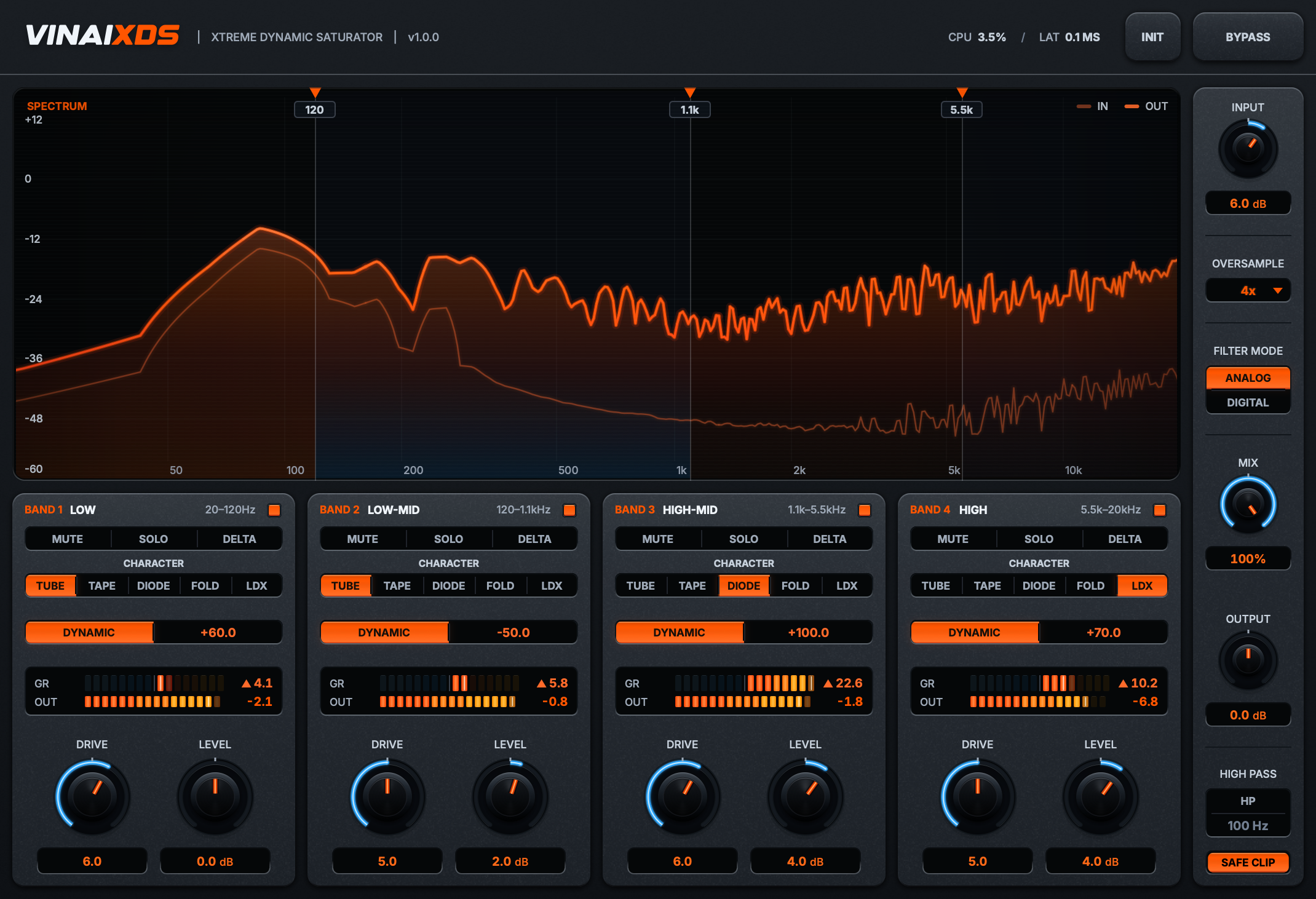
Drive the source before you widen it. Four bands, five distortion characters each, with a real-time analyzer.

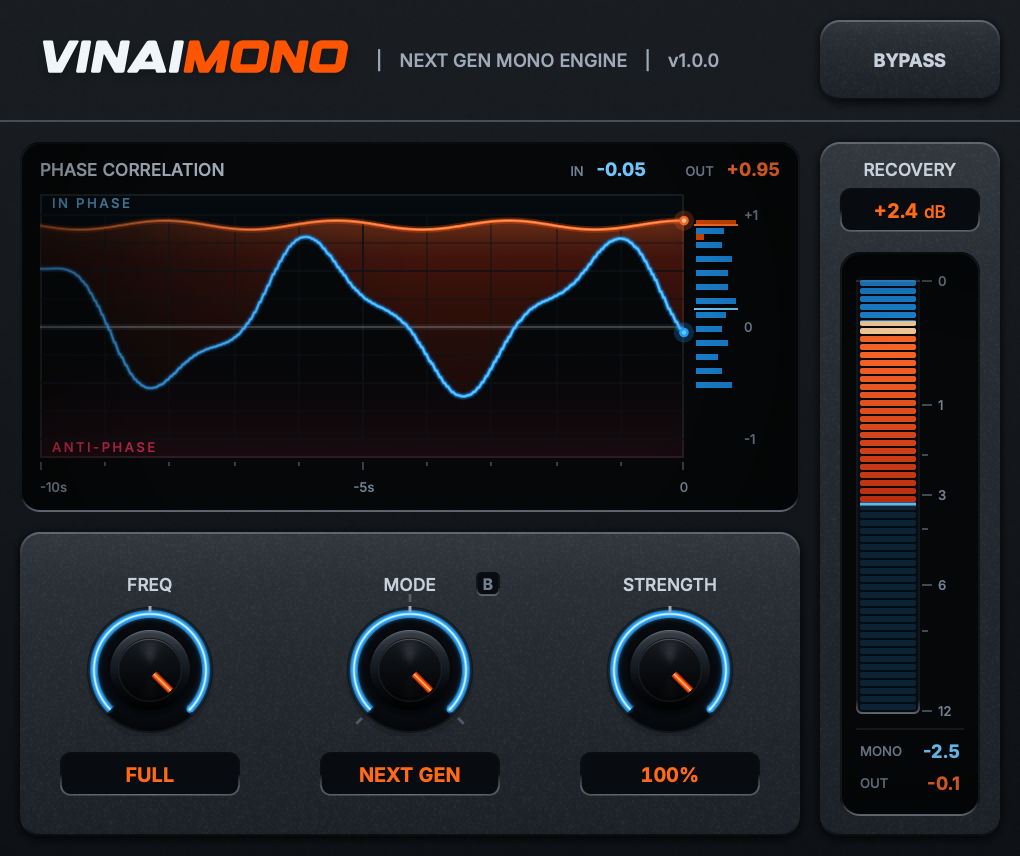
The counterweight to width: rebuild low-end energy lost to phase conflict for a solid mono that never sounds hollow.

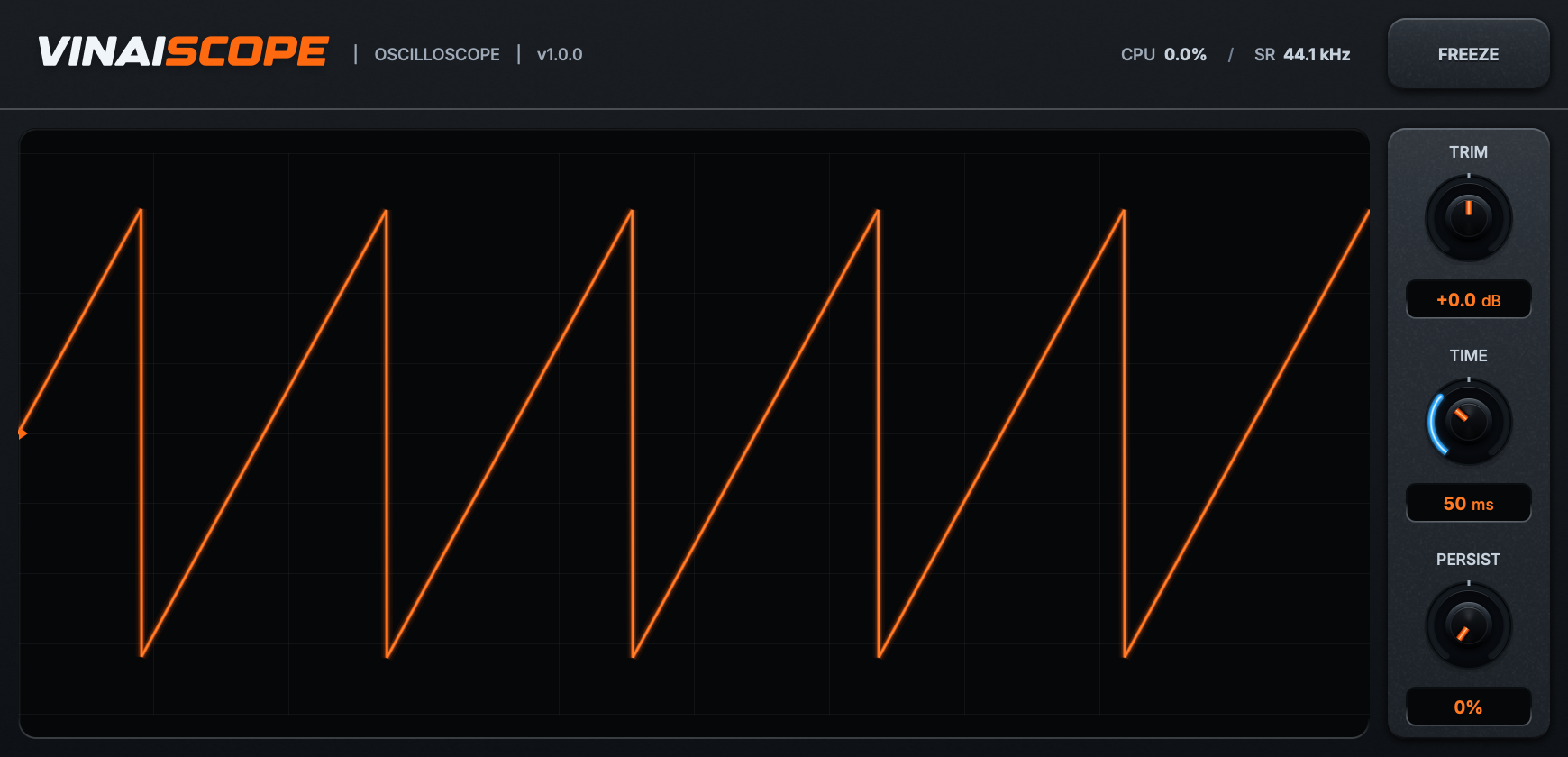
Verify what the widener does to the waveform. Bit-transparent real-time monitoring with phosphor persistence.