VINAIanalog Manual
The world's first analog cohesion engine. It gives clean, sterile in-the-box signals the glue, depth and three-dimensional cohesion of vintage transformer-coupled signal paths. The Analog Cohesion Engine drives it, and an IN / OUT waveform display shows the work. Unity-gain, no EQ, no distortion. v1.0.0 · VST3 · AU.
01Overview
VINAIanalog models the multi-stage character a vintage analog path imparts as audio passes through it: the subtle dimensionality that makes elements sit together instead of stacking on top of each other. Digital signals are flawless and flat, and that's exactly the problem: analog adds the cohesion, depth and three-dimensional space that flat lacks, while leaving the source completely intact. No EQ. No distortion. Pure analog color.
It's built on the Analog Cohesion Engine, which is unity-gain by design. Louder never gets mistaken for better, so what you hear is the color and nothing else. INTENSITY steps through five named tiers of analog density (LOW, MID, HIGH, EXTREME, UNREAL), RANGE LOW and RANGE HIGH place that color exactly where you want it, MODE picks between two voicings of the chain, and MIX trims the whole thing to taste.
02The interface
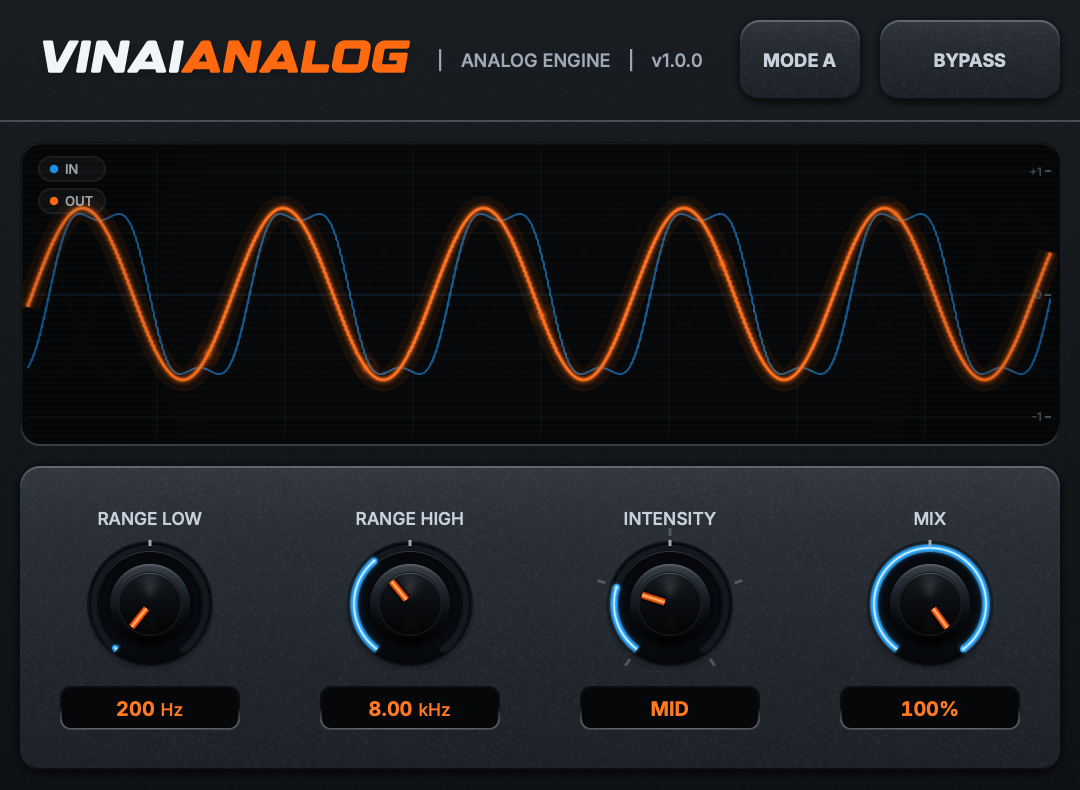
- The IN / OUT waveform display draws the incoming signal against the colored output on a phosphor trace with afterglow, over a fine graticule, so you can see the work the engine is doing.
- INTENSITY: the main dial; five tiers of analog density, LOW to UNREAL, from a faint warmth to a thick, present analog tone.
- RANGE LOW · RANGE HIGH are the two focus controls that pin the color to a band, from the low edge up to the top end.
- MODE: the small card left of BYPASS, switching between the two voicings of the engine. Its label turns lava while B is running, so the active voicing reads at a glance.
- MIX · BYPASS: a global 0–100% depth for the analog color, plus a latency-compensated true bypass.
03Knobs & buttons
Intensity
Five tiers of analog density: LOW, MID, HIGH, EXTREME and UNREAL, from the faintest warmth that just takes the digital edge off to a thick, present analog tone. Every step is internally crossfaded, so you can ride the dial live without a single click.
Range Low
Focuses the lower edge of the colored band: 1 Hz to 22 kHz. Pin it low for weight and body.
Range High
Focuses the upper edge of the colored band, 1 Hz to 22 kHz, always at least 50 Hz clear of the low edge. Open it up top for air and sheen.
Mode
Two voicings of the modelling chain, A and B. A spreads the color across the whole band you set with RANGE LOW and RANGE HIGH. B gathers it into something tighter and denser, anchored at RANGE LOW, and RANGE HIGH has no effect while B is on. A is the default. Switching is click-free, and the choice is stored with the preset.
Mix
How deep the analog color goes, 0–100%, smoothed. Pull it back to tuck the effect under the source.
Bypass
Latency-compensated true bypass for honest A/B against the untouched signal.
04The three voicings
Think of these as feelings, not modes: starting points that pair an Intensity tier with a Range focus. Dial in the vibe, then trim to taste with Mix.
SHEEN
A whisper of top-end air. Gentle Intensity, focused high: the finishing touch that opens up a bus.
GLUE
Mid-focused cohesion for groups and stems. Elements lock together and stop fighting for the same space.
DEPTH
Rich, dimensional color across a full mix. Higher Intensity, broad range. The digital edge gone, body and space in its place.
05Under the hood
The Analog Cohesion Engine is a multi-stage analog-modelling chain that imparts the dimensional character of vintage signal paths. It is strictly unity-gain: no EQ, no distortion, no added harmonics, just the multi-stage character of the path itself, applied to the source and nothing more.
Signal flow
Audio enters the chain, passes through the successive analog-modelling stages that build the dimensional character, with MIX setting how deep the engine works, smoothed so every move is click-free, before output. RANGE LOW and RANGE HIGH define the band the engine acts on; everything outside that focus passes through untouched. The IN / OUT waveform display taps the signal pre- and post-engine so the work the chain is doing is visible in real time.
- Multi-stage modelling chain: the dimensional character is built across multiple modelling stages, not a single filter; INTENSITY scales the depth of that chain across its five tiers.
- Strictly unity-gain means no EQ curve, no waveshaping, no harmonic generation; level in equals level out, so the only thing that changes is the color.
- Per-sample coefficient interpolation: all internal coefficients are interpolated per sample, so parameter moves are zipper-free under fast automation.
- Click-free Intensity: changes between Intensity tiers are handled by an internal crossfade, so the dial can be ridden live without discontinuities.
- Nyquist-clamped stability holds every internal coefficient below Nyquist at each sample rate, keeping the chain stable from 44.1 kHz up through high-rate sessions.
- Reported, PDC-compensated latency: the processing depth is reported to the host and fully delay-compensated, so the plugin stays in time with the rest of your session and bypass A/Bs are time-honest. Latency scales with Intensity and is always reported accurately.
- Two voicings: MODE changes how the chain spreads its character over the band. A covers the whole RANGE window, B concentrates it around RANGE LOW. Nothing else in the chain differs between the two, so the switch is a clean A/B on character alone. The per-sample interpolation above absorbs the change, so it lands without a click.
- Smoothed MIX: the 0–100% depth control is parameter-smoothed, so it moves without steps or clicks.
06Measured
Measured in-house (headless host + numpy/scipy), 48 kHz.
| Latency | 16 samples · 0.33 ms @ 48 kHz at default (scales with Intensity, 64 samples max; PDC-compensated) |
| Bypass | Bit-exact, nulls to the measurement floor |
| Magnitude flatness | ±0.00 dB, 20 Hz–20 kHz |
| Self-noise | None: silence in, silence out |
| Sample rate tested | 48 kHz |
07Specifications
| Type | World's First Analog Cohesion Engine |
| Character | Modeled vintage transformer-coupled signal-path cohesion & depth |
| Intensity | 5 tiers, LOW · MID · HIGH · EXTREME · UNREAL · click-free (internal crossfade) |
| Mode | A · B, two voicings of the engine · click-free |
| Range | Range Low 1 Hz–22 kHz · Range High 1 Hz–22 kHz (the high edge stays at least 50 Hz clear of the low edge) |
| Mix | 0–100% depth, smoothed |
| Gain | Unity: no EQ, no distortion |
| Display | IN / OUT phosphor waveform · graticule |
| Latency | 16 samples · 0.33 ms @ 48 kHz at default · PDC-compensated (scales with Intensity, 64 samples max) |
| Formats | VST3 · AU |
| Systems | macOS 12+ (Universal) · Windows 10+ · 64-bit |
| Version | 1.0.0 |