VINAIcore Manual
A next-gen three-band loudness processor driven by a single control. Splits the signal into low, mid and high, drives each band on its own envelope, then pins the peaks against a hard 0 dBFS ceiling at zero latency. The Adaptive Loudness Core governs the whole chain. v1.0.0 · VST3 · AU.
01Overview
VINAIcore splits the incoming signal into three frequency bands with Linkwitz-Riley crossovers at 200 Hz and 3 kHz (24 dB/oct, phase-coherent). The low band runs mono for a tight, centered punch; mid and high stay stereo to keep width and air intact. Each band carries its own envelope follower, with tanh saturation on the low and high bands and a 5 Hz DC blocker on each saturated path, then the bands recombine into a final safety ceiling.
The whole treatment is governed by the Adaptive Loudness Core and driven by one control. AMOUNT blends the processed bands in over the dry signal. From 0 to 100% it brings low, mid and high in together, in a single move. No band balancing, no threshold hunting: turn it up until it sits, then leave it.
02The interface
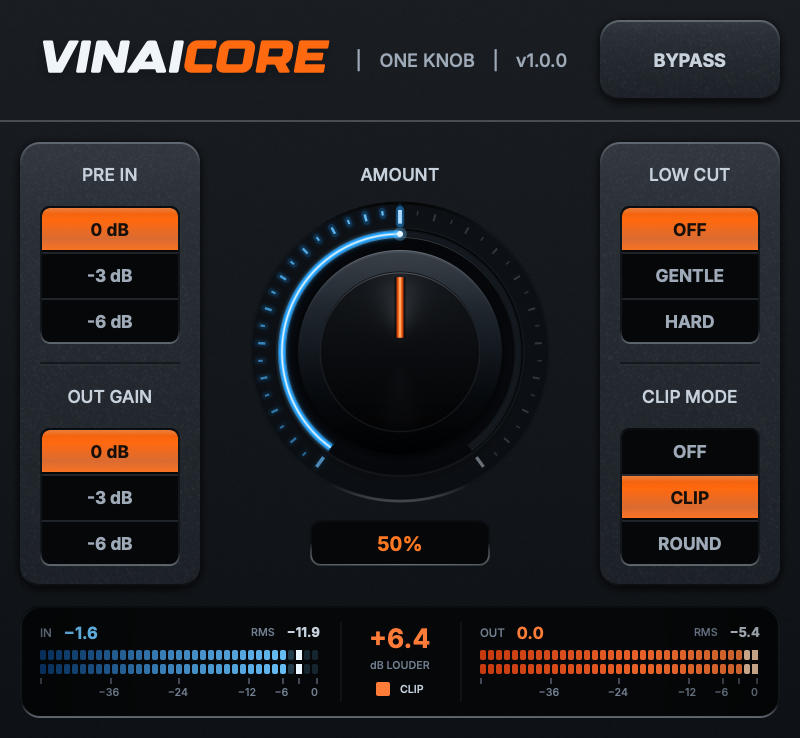
- AMOUNT knob (center): the one control, set in a milled recess with an LED corona that lights up to the pointer; 0–100% blends in the processing of all three bands at once.
- Meter bridge (IN · OUT): under the controls, input and output peak and RMS on a −48 to 0 dBFS scale with peak hold, how many dB louder the output reads, and a CLIP lamp that lights when the final clipper touches a sample.
- Final clipper switch: CLIP · ROUND · OFF, the last stage of the chain.
- Side strips: Pre In Gain and Out Gain on the left, Pre Low Cut above the final clipper on the right, with Bypass in the top bar.
03Knobs & buttons
AMOUNT
The one knob, 0–100%, blends the processed low, mid and high bands in over the dry signal, all three together in one move
Final clipper
The last stage of the chain, after Pre Low Cut and Out Gain: CLIP (hard 0 dBFS) · ROUND (soft tanh knee) · OFF
Pre Low Cut
High-pass after the master stage, ahead of the final clipper. Choose OFF · GENTLE (12 dB · 115 Hz) · HARD (24 dB · 115 Hz)
Pre In Gain
Trim into the curve: 0 / −3 / −6 dB
Out Gain
Trim into the final clipper, 0 / −3 / −6 dB
Bypass
Click-free bypass of the whole processor
04The final clipper
CLIP
Hard ceiling at 0 dBFS. Everything under full scale passes untouched; the top is pinned, not shaped.
ROUND
Soft tanh knee: bends earlier into the limit for a rounder, gentler finish.
OFF
Bypass the final clip and let core run hot into your own chain. Three bands, no ceiling.
05Under the hood
Signal flow
Pre In trim → 20 Hz high-pass → 3-way Linkwitz-Riley split → per-band envelope-driven gain, with tanh saturation on low and high → band recombination, blended against the dry by AMOUNT → master stage (envelope gain, tanh saturation, DC block) → Pre Low Cut → Out trim → final clipper. The bands are reconstructed by complementary LR4 filters, so the magnitude sum is flat and phase-coherent across both crossover points. The whole chain runs at native rate with no lookahead: the plugin reports 0 samples of latency to the host.
- Crossovers are 4th-order Linkwitz-Riley (24 dB/oct), implemented as cascaded Butterworth sections, at 200 Hz (low/mid) and 3 kHz (mid/high). LR4 sums to a flat magnitude response with an allpass-equivalent phase, so reconstruction is gap-free.
- Band routing sums the low band to mono after its saturation and DC blocker, for a centered low end; mid and high remain fully stereo to preserve width and air.
- Per-band saturation gives each band its own envelope follower driving its gain, with a tanh saturation stage on the low and high bands. AMOUNT blends all three processed bands against the dry signal at once, so a single control brings low, mid and high in together, in lockstep.
- Safety ceiling: the final clipper is the last stage of the chain, after Pre Low Cut and Out trim, and runs at native rate. CLIP is a hard clamp at 0 dBFS, bit-transparent below full scale; ROUND is a soft tanh knee that bends earlier; OFF removes the clamp and lets the bands run hot into the next stage.
- DC blocking puts a first-order DC blocker (5 Hz corner) on the low, high and master paths, so asymmetric saturation can't accumulate a DC offset before recombination.
- Latency is zero: no lookahead, no oversampling, no linear-phase stage. The plugin reports 0 samples to the host in every mode.
- Output integrity means silence in yields silence out: the processor injects no idle tone, hiss or dither floor.
06Measured
Measured in-house (headless host + numpy/scipy), 48 kHz.
| Latency | 0 samples · zero latency, every mode |
| Bypass | Bit-exact, nulls to the measurement floor |
| Self-noise | None (silence in, silence out) |
| THD @ full AMOUNT | 0.65%, low-order and musical (1 kHz) |
| Crossovers | LR4 (24 dB/oct) @ 200 Hz / 3 kHz |
| Sample rate tested | 48 kHz |
07Specifications
| Type | Next-gen 3-band loudness processor (Adaptive Loudness Core) |
| Bands | 3: Low (mono) / Mid (stereo) / High (stereo) |
| Crossover | LR4 24 dB/oct, splitting at 200 Hz & 3 kHz |
| Primary control | AMOUNT (0–100%) · blends all three processed bands against the dry signal |
| Final clipper | CLIP (hard 0 dBFS ceiling) · ROUND (soft tanh knee) · OFF |
| Pre low cut | OFF · GENTLE (12 dB · 115 Hz) · HARD (24 dB · 115 Hz) |
| Pre / Out gain | Pre In 0 / −3 / −6 dB · Out 0 / −3 / −6 dB |
| Safety ceiling | Hard clamp at 0 dBFS · bit-transparent below full scale |
| Engine | Reactive, zero lookahead · native rate throughout |
| Metering | IN / OUT peak & RMS meter bridge · dB LOUDER readout · CLIP lamp |
| Formats | VST3 · AU |
| Systems | macOS 12+ (Universal) · Windows 10+ · 64-bit |
| Version | 1.0.0 |