VINAImono Manual
Intelligent mono and phase recovery. Instead of a naive (L+R)/2 fold that hollows out when your left and right drift out of phase, VINAImono analyzes phase conflict per band and rebuilds the lost energy. It runs on the Phase Reconstruction Core, with a scrolling correlation history watching every move. v1.0.0 · VST3 · AU.
01Overview
VINAImono is an intelligent mono / phase-recovery tool. A simple (L+R)/2 fold sounds fine until your left and right channels drift out of phase. Then the summed signal cancels and the bottom drops out. The Phase Reconstruction Core measures phase conflict per frequency band and rebuilds the energy that plain summing throws away, so you get solid, translatable mono without the hollow.
The flagship NEXT GEN engine splits the signal at ~300 Hz and runs independent phase-conflict correlators on the bass and the mid/high bands. Where it detects cancellation it applies frequency-conscious gain compensation; coherent material passes untouched. A scrolling phase-correlation display and a recovery strip show you exactly what's happening, all at zero latency.
02The interface
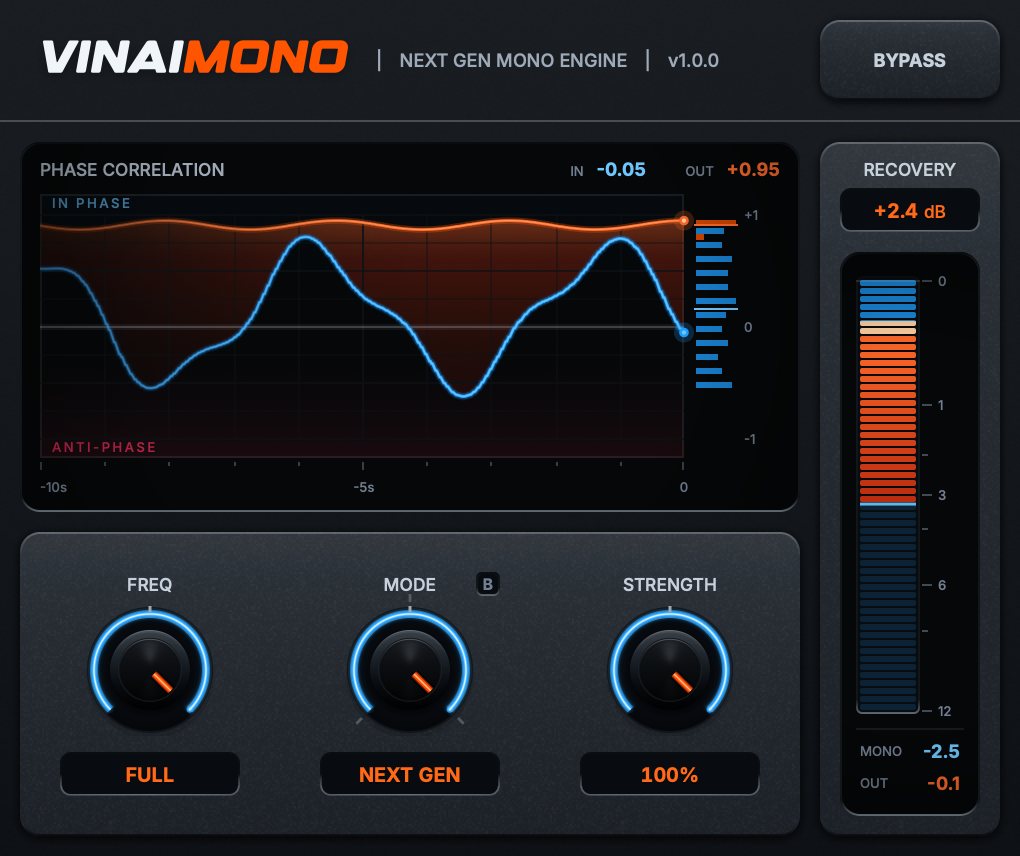
- The Phase-correlation display scrolls 10 seconds of history in two lanes, the input in blue and the output in lava, both running from +1 (in-phase) down to -1 (anti-phase). A red wash marks the anti-phase half, a histogram beside the scale shows where each lane spent those 10 seconds, and smoothed IN and OUT readouts sit in the header.
- The Recovery strip measures the job itself. MONO is the power a plain fold throws away, OUT is what is still missing once the engine has worked, and the RECOVERY box on top is the difference between them: the dB you got back. The column runs from 0 down to -12 dB and holds the recent peak of the loss.
- The MODE knob steps between Original, Classic and Next Gen to A/B exactly what the smart engine is putting back.
- Two more Knobs flank it: Strength sets the wet/dry amount of the reconstruction; Mono Freq sets the line below which everything folds to mono.
03Knobs & buttons
Compare Mode
Selects the engine: Original (dry reference) · Classic ((L+R)/2 fold) · Next Gen (dual-band reconstruction)
Strength
Wet/dry amount of the mono processing, 0–100%, blending the reconstructed signal against the dry source
Mono Freq
Crossover below which the signal is folded to mono, stereo preserved above. Runs 40 Hz to 20 kHz, default FULL (whole spectrum)
Bypass
True-bypass the plugin for an instant before/after comparison
04The three modes
ORIGINAL
Dry pass-through reference. The unprocessed stereo signal, for instant A/B against everything else.
CLASSIC
The simple (L+R)/2 mono fold. Honest summing, and an audible reminder of what phase conflict costs you.
NEXT GEN
The flagship dual-band reconstruction. Splits at ~300 Hz, corrects phase conflict per band and rebuilds the energy a plain fold would lose.
05Under the hood
The NEXT GEN engine is a per-band correlation-driven reconstruction stage. Rather than collapsing the stereo field with a single sum, it isolates the bass from the mid/high, measures how coherent each band is over time, and applies only as much power compensation as the detected cancellation calls for. All of it is sample-rate-invariant, all of it at zero latency.
Signal flow
- Band split: the L/R stereo signal is divided into a low band and a high band at ~300 Hz using one-pole (first-order, 6 dB/oct) crossovers. The two complementary bands reconstruct back to the full-range signal, so the split is transparent when no correction is applied.
- Per-band correlation: each band gets its own independent sliding-window correlator that tracks the instantaneous L/R phase relationship. The windows are tuned to the content: the low band integrates over a long window (≈10 ms @ 48 kHz) to read sustained bass coherence, while the high band uses a short window (≈1.5 ms @ 48 kHz) so it reacts quickly to transient phase shifts.
- Frequency-conscious power compensation: when a correlator detects cancellation, the engine restores the lost energy with a band-specific make-up gain. The amount is scaled per band: up to +6 dB in the low band and up to +15.6 dB in the high band, reflecting how much more high-frequency energy a destructive sum can throw away.
- Tail-aware side-rescue lane: a dedicated side path that recovers stereo information that would otherwise be lost into the sum, with tail-awareness so decays and reverb tails are preserved instead of being clamped to silence.
- SR-invariant smoothing: every detector window, gain trajectory and compensation curve is smoothed against a time constant rather than a fixed sample count, so the engine behaves identically at 44.1, 48, 96 kHz and beyond. No coefficient drift, no re-tuning per session sample rate.
- Coherent-input guarantee: for a perfectly coherent input (L = R) the math collapses to exactly (L+R)/2, so no compensation engages and no coloration is introduced. The engine only ever acts on material that is actually cancelling.
- Latency: the entire chain is feed-forward with no look-ahead buffer, so reported and actual latency are both zero samples. It can sit on the master while you track without any delay-compensation penalty.
- Metering internals: the phase-correlation history is computed from the same broadband L/R relationship and smoothed before display for a stable, trustworthy readout; the recovery strip works on power ratios, comparing the energy the mono sum keeps against the energy present before any cancellation. That ratio is read twice, once on the input and once on the output, and the gap between the two readings is the recovered figure, so the strip reports a measured result rather than the settings you dialled in.
06Measured
Measured in-house (headless host + numpy/scipy), 48 kHz.
| Latency | 0 ms / 0 samples, zero-latency |
| Bypass | Bit-exact, nulls to the measurement floor |
| Crossover | ~300 Hz dual-band reconstruction |
| Self-noise | None: silence in, silence out |
| Sample rate tested | 48 kHz |
07Specifications
| Type | Intelligent mono / phase-recovery tool (Phase Reconstruction Core) |
| Modes | Original · Classic ((L+R)/2) · Next Gen (dual-band reconstruction) |
| Strength | 0–100% wet/dry |
| Mono frequency | 40 Hz – 20 kHz: mono below, stereo above · default FULL |
| Metering | Scrolling phase-correlation history (+1 to -1) + recovery strip (mono loss and dB recovered) |
| Latency | Zero latency |
| Formats | VST3 · AU |
| Systems | macOS 12+ (Universal) · Windows 10+ · 64-bit |
| Version | 1.0.0 |