VINAIxds Manual
Four-band parallel multiband distortion. Split any signal into four bands and drive each through its own character. It all runs on the Spectral Saturation Core, with a real-time analyzer overlaying every harmonic you add. v1.0.0 · VST3 · AU.
01Overview
VINAIxds splits the incoming signal into four frequency bands with Linkwitz-Riley crossovers, then drives each band through its own distortion character, all in parallel, so the clean and distorted energy sit together. A 2048-point real-time analyzer overlays input and output so you can see the harmonics you create, with the three crossover handles living right on the graph.
Each band carries the same five characters (Tube, Tape, Diode, Fold and LDX), and a global Filter Mode sets whether the bands split and recombine the Analog way or the Digital way. Distort the low end into a wall while keeping the highs glassy and clean.
02The interface
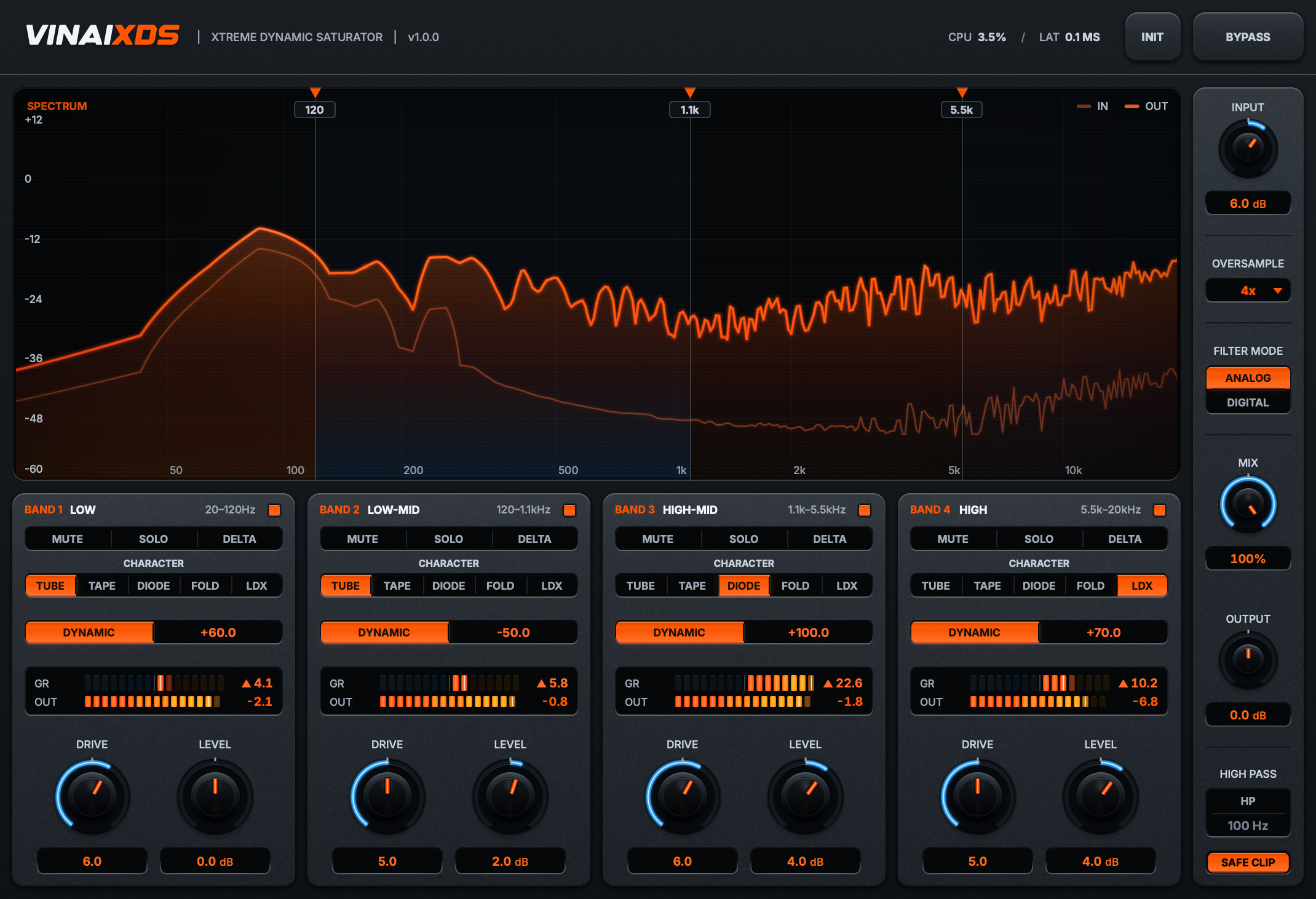
- SPECTRUM analyzer (top): input vs. output spectrum overlay; drag the three crossover handles to set the band splits. A coloured wash rises from the floor of each band that has Dynamic armed: lava where it is pushing, blue where it is containing.
- Band cards (LOW · LOW-MID · HIGH-MID · HIGH) each carry their own CHARACTER, Drive, Level, Dynamic, a Mute/Solo/Delta row and a GR / OUT readout pair. The lit square in the card header is Proc: on means the band is processing, off means it passes clean.
- Global column (right): Input, Oversample, Filter Mode (Analog/Digital), Mix, Output, High Pass and Safe Clip.
03Knobs & buttons
Per band
Character
Selects the distortion engine for the band: Tube · Tape · Diode · Fold · LDX
Analog / Digital
The global Filter Mode. It sets how the four bands cross over and recombine, not a per-band tone. Digital keeps the crossover splits clean and surgically separated; Analog lets the band edges interact and bleed the way analog filters do, for a more connected, less clinical recombination.
Drive
Amount of distortion driven into the band, 0–10
Level
Output level of the band, ±16 dB
Dynamic
Envelope-driven excitation, −100 to +100. Positive pushes the band harder into its engine on hits, negative eases it out. See The Dynamic engine below
Proc
The lit square in the card header. Off bypasses the band, which then passes clean instead of leaving the mix
Mute / Solo
Drop the band out of the sum, or hear it on its own
Delta
Listen to only what this band adds, the harmonics you're generating
GR / OUT
Live per-band LED meters, each with its number. GR is the band's total processing, what comes out against what went in, in dB: lava when the band comes out louder, blue when it comes out quieter. OUT is the band's own output peak after Drive and Level, on a −48 to 0 dBFS ladder
Crossovers & global
Crossover handles
Three movable splits on the analyzer, covering roughly 40–500 Hz, 180 Hz–3.2 kHz and 1–12 kHz
Input / Output
Gain into and out of the plugin, ±24 dB each
Mix
Global dry/wet for parallel blending of the whole effect
High Pass
High-pass filter on the summed output, just before Safe Clip, to strip sub-bass ahead of the ceiling. HP arms it; the frequency sits right below in the same cavity and is set by dragging it or by typing a value
Safe Clip
Optional final brick-wall clamp at 0 dBFS to stop the output overshooting; transparent below full scale
Oversample
2× / 4× / 8× / 16×. Higher kills aliasing from heavy drive (default 4×)
04The five characters
TUBE
Warm, even-harmonic glow with gentle asymmetry. The classic, refined.
TAPE
Soft saturation, tamed transients and a rounded top end. Glue.
DIODE
Asymmetric clipper edge with odd-harmonic bite that cuts through a dense mix.
FOLD
Wavefolding chaos. Metallic, gated, gloriously broken. For when subtle is wrong.
LDX
VINAI's own, uniquely engineered distortion: aggressive, transient-aware grit found in no other plugin.
05The Dynamic engine
Dynamic is the D in XDS: a per-band envelope follower that modulates how hard the band is driven into its distortion engine, in real time. Arm it with the Dynamic switch and set an amount from −100 to +100.
Positive amounts push. When energy arrives in the band, the signal is driven deeper into the saturation, up to 12 dB of extra excitation on top of the Drive setting. The louder the band gets, the harder it leans into the engine, and as the sound decays the push relaxes with it. Because the excitation drives the signal into the engine rather than turning the Drive knob for you, it never runs out of range. Drive 10 with Dynamic +100 still pushes.
Negative amounts contain. The same envelope eases the band out of the saturation on hits, so transients pass cleaner and punchier while the quieter material between them keeps the full character. Think of it as transient protection built into the distortion itself.
Read it on the analyzer. A wash rises from the floor of the display under each armed band: lava when Dynamic is pushing, blue when it is containing. It grows with the amount of work being done and never climbs past half the cavity, so it colours the band without ever covering the trace. The wash is where Dynamic shows itself: the GR meter on the band card reads the band's total processing, Dynamic included.
Feel. The detector runs a 2.5 ms attack and an 80 ms release, so it rides each hit and breathes back over the decay. At Drive 0 the band is clean by design and Dynamic stays silent: it amplifies the processing you set, it never invents it.
06Under the hood
Signal flow
The signal runs from IN gain into a Linkwitz-Riley crossover that splits it four ways. Each band drives in parallel through its own character, oversampled: upsample, shape with one of the five kernels, block DC on the added component only, then decimate back to base rate. The four bands recombine, pass the global Mix blend and OUT trim, then an optional pre-clip HP filter and an optional Safe Clip brick-wall at 0 dBFS. Two FFT taps, one before the split and one after recombination, feed the analyzer overlay off the audio path.
- Crossover topology: Linkwitz-Riley filters split the spectrum into four bands. LR sections sum with flat magnitude and matched phase at each crossover, so the four bands recombine to unity when no drive is applied.
- Parallel band processing: each band runs its own waveshaper (one of five characters, Analog- or Digital-voiced) in parallel, not in series. Bands are phase-aligned before they are summed, so the recombined output stays coherent rather than smearing the splits.
- Oversampling & anti-aliasing: polyphase-IIR half-band oversampling at 2× / 4× / 8× / 16× (default 4×) runs the nonlinear stages above base rate so the harmonics generated by heavy drive stay below Nyquist. The oversampler alone carries the anti-aliasing, so higher factors matter most on aggressive characters and hot drive. There is no antiderivative or ADAA smoothing in the shapers: the transfer curve is evaluated per sample, and aliasing is set by the oversampling factor alone. Every band and the dry Mix reference pass the same oversampler, so they share its group delay and recombine coherently.
- DC block: a one-pole high-pass at 5 Hz sits inside each band and is applied to the added component only (out = in + block(shaped − in)). Asymmetric characters like Tube and Diode inject DC, and this removes it without touching the clean band, so a band at zero drive is a true null rather than a high-passed copy.
- Latency & PDC: the polyphase-IIR oversampler adds a small fixed latency. That figure is reported to the host and PDC-compensated, so the wet path stays sample-accurate against the rest of the session; it scales with the oversampling factor.
- Metering: a 2048-point FFT drives the input + output analyzer overlay, so you read the harmonic content you add directly against the source spectrum. The analyzer taps are measurement-only and do not feed back into the audio.
- Safe Clip: the optional final stage is a native-rate brick-wall clamp that pins the sample peak at 0 dBFS. It adds no latency and stays transparent below full scale, so it only ever catches an overshoot rather than coloring the level.
07Measured
Measured in-house (headless host + numpy/scipy), 48 kHz.
| Latency | 4 samples · 0.08 ms @ 48 kHz at default 4× (scales with oversampling) |
| Magnitude flatness | ±0.01 dB, 20 Hz–20 kHz (neutral path) |
| Bypass | Bit-exact, nulls to the measurement floor |
| Anti-aliasing | −59 dBc (2×) · −82 dBc (4×) · −103 dBc (8×) · −108 dBc (16×), measured on a 2.3 kHz tone at hard drive |
| Channel separation | No measurable crosstalk · the Dynamic detector is stereo-linked |
| Self-noise | None: digital silence in, digital silence out |
| Sample rate tested | 48 kHz |
Reference-grade at 8×
Pushed to full drive, xds holds aliasing at −103 dBc with 8× oversampling, past the −90 dBc line and far below a typical plugin. Clean saturation, no digital fizz.
grey = typical plugin · representative08Specifications
| Type | Parallel multiband distortion (Spectral Saturation Core) |
| Bands | 4: Low / Low-Mid / High-Mid / High |
| Crossover | Linkwitz-Riley, 3 movable handles |
| Characters | 5 per band: Tube · Tape · Diode · Fold · LDX |
| Filter Mode | Analog / Digital, global · a proprietary crossover algorithm shaping how the bands separate & recombine |
| Analysis | 2048-point real-time FFT, input + output overlay |
| Oversampling | 2× / 4× / 8× / 16× polyphase-IIR half-band (default 4×) |
| Latency | 4 samples · 0.08 ms @ 48 kHz at default 4×, PDC-compensated (scales with oversampling) |
| Formats | VST3 · AU |
| Systems | macOS 12+ (Universal) · Windows 10+ · 64-bit |
| Version | 1.0.0 |