VINAIclip Manual
A transparent final-stage clipper for the last link in the chain: three harmonic algorithms, a morphing knee, a native 0 dBFS ceiling and Delta listen so you hear exactly what you shave. Powered by the Transparent Ceiling Engine. v1.0.0 · VST3 · AU.
01Overview
VINAIclip is a final-stage clipper built for the very end of the chain: after your dynamics, before (or instead of) the limiter. It clamps the signal to a hard ceiling and turns the overshoot into harmonics rather than distortion you didn't ask for. The whole thing runs on the Transparent Ceiling Engine: a ceiling you can trust, with a morphing knee that goes from a clean brick-wall corner to a rounded, musical curve.
You pick the harmonic signature from three algorithms (Hard, Warm and Tube), set the threshold by ear with Delta listen soloing only what's being removed, and land your peaks right at 0 dBFS with a native ceiling. Oversampling runs up to 16× to keep aliasing out of the harmonics you just generated.
Why we kept it transparent
After rounds of internal testing we made a deliberate call: push VINAIclip to the most transparent a clipper can be, and stop there. It is tuned for electronic music, where the groove lives in the transients and the detail, and where a clipper on the master touches every one of them. Nothing in the default signal path is there to add character you didn't ask for.
Transparent here is not a slogan. It is how the engine is built. The clip is a memoryless waveshaper with no time constants, so it never smears an attack the way a limiter would. At 1× anything below the ceiling passes bit-exact; with oversampling on it goes through a linear-phase filter pair, delayed but never phase-shifted. The ceiling itself is a native-rate clamp with zero added latency, so engaging it never shifts your timing or your phase. There is no always-on filtering tilting the waveform, and HARD stays a true brick wall instead of a rounded curve, so what you see on the scope is exactly what leaves the plugin.
We made that call knowing the tradeoff. Chasing the lowest possible aliasing number can round a transient or bend a flat top, and for this music that costs more than it buys. So we chose fidelity to the waveform and to your transients over a spec-sheet contest. When you do want weight and colour, TUBE is right there for it. But the spine of the plugin is to get out of the way: the maximum transparency a DSP can give you, no compromises, with sonic latency kept to the minimum.
02The interface
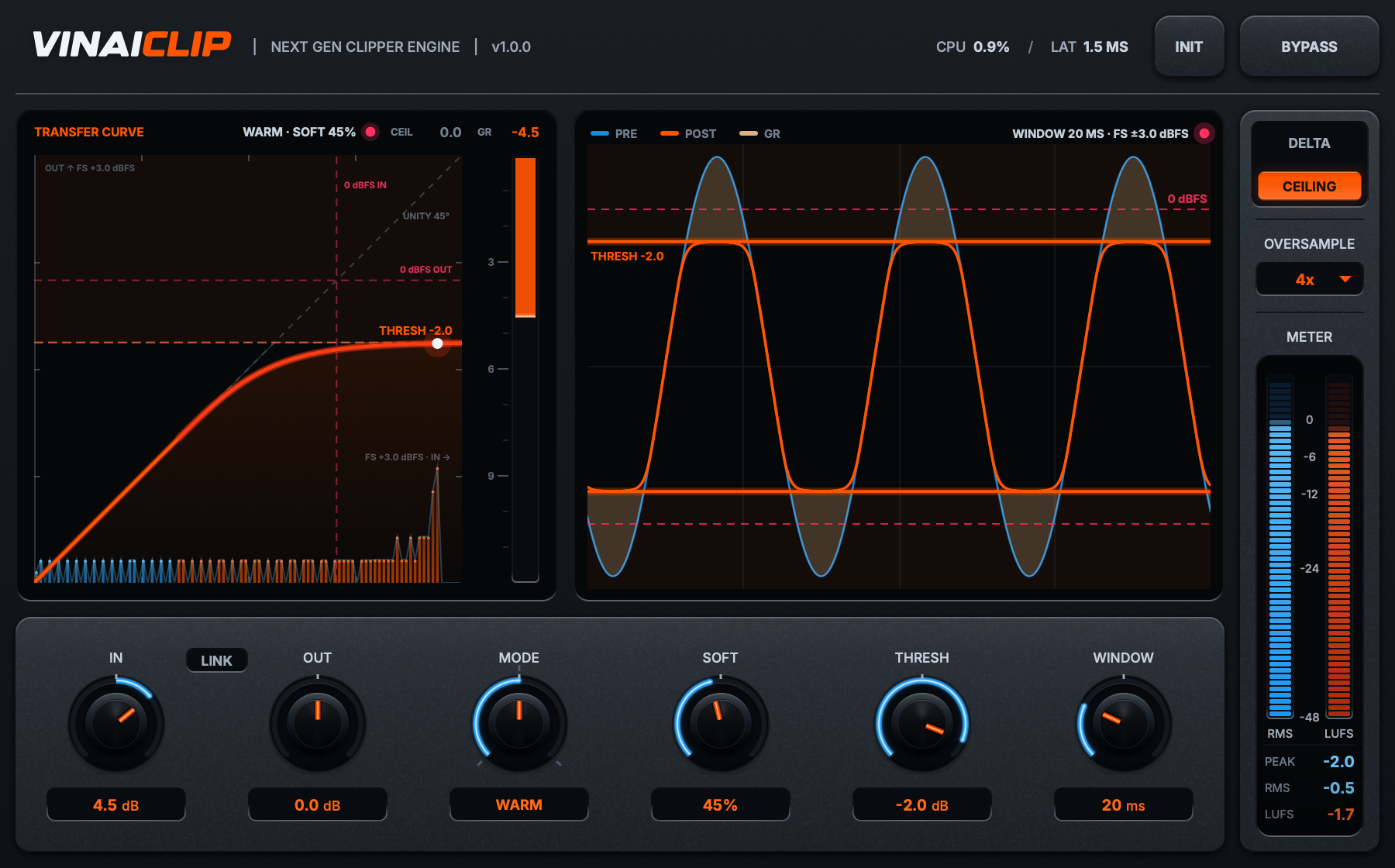
- Scope (centre): pre / post / delta clip view showing the flat-topped waveform and exactly how much is being shaved.
- Algorithm selector: Hard · Warm · Tube, each its own clipping kernel.
- Gain & clip controls: IN, OUT, THRESH and SOFT, with the LINK toggle that mirrors IN/OUT for instant makeup.
- Ceiling & quality: CEILING and the OVERSAMPLE selector (1×–16×).
- Transfer curve (left): the live curve for the current MODE and SOFT, with the signal dot riding it, an input level histogram and a GR lane beside the plot. The header reads CEIL, the gain reduction of the CEILING clamp alone, right before GR: grey at 0.0, lava while the clamp works.
- Metering (right): RMS and LUFS columns on one scale from −48 to +6 dBFS, with PEAK, RMS and LUFS readouts below, plus the DELTA listen toggle.
03Knobs & buttons
Gain & clip
IN
Drive into the clipper, ±12 dB: how hard you push the signal against the ceiling
OUT
Output trim after clipping, ±12 dB, to set your final level
THRESH
Clipping ceiling, −24 dB to 0 dB. Everything above it is clamped
SOFT
Knee shape, 0–100%: rounds the corner on WARM and TUBE (HARD is a fixed brick wall, so no effect there)
MODE
Selects the clipping algorithm: Hard · Warm · Tube
LINK
Mirrors IN and OUT so drive added in is trimmed back out automatically, for instant gain-matched A/B
Ceiling, quality & metering
CEILING
Native-rate clamp that pins your sample peaks exactly at 0 dBFS, loud and clean, with zero added latency. On by default
OVERSAMPLE
1× / 2× / 4× / 8× / 16×: higher kills aliasing from hard clipping (default 4×, a clean KClip-style start; drop to 1× for zero latency)
DELTA
Solo only what the clipper removes: the harmonics and transients you're shaving off
Metering
RMS and LUFS columns with PEAK, RMS and LUFS readouts, GR and CEIL readouts on the transfer curve, plus pre / post / delta scope
WINDOW
Length of the waveform view on a log sweep, from 128 samples up to 5 s at 44.1 and 48 kHz (shorter at higher rates), 20 ms by default. Display only, never touches the audio
INIT / BYPASS
INIT returns IN, OUT, MODE, SOFT, THRESH, DELTA and LINK to their defaults, shows every scope layer again and puts WINDOW back to 20 ms. BYPASS, OVERSAMPLE and CEILING stay as they are. BYPASS itself is time-aligned and click-free
04The three algorithms
HARD
Brick-wall clamp: pure odd harmonics, aggressive and uncompromising. The transparent ceiling.
WARM
A tanh kernel with dense odd harmonics, the gentlest and most musical of the three. Smooth glue.
TUBE
Asymmetric tanh for even-harmonic, second-order tube warmth. Colour and weight, not just a ceiling.
05Under the hood
At its core VINAIclip is a memoryless, per-sample waveshaper. It has no time constants, so it can clamp a transient peak instantly without the attack/release smear of a limiter. The "Transparent Ceiling Engine" is everything wrapped around that shaper: oversampling, anti-aliasing, the native ceiling and metering, all phase-linear on the audio path.
Signal flow
Upsample (polyphase FIR) → IN gain → per-sample waveshaper (one of three curves, with the Softness knee blended in) → OUT trim, on the same oversampled clock as IN → downsample/decimate (matching FIR) → optional native 0 dBFS ceiling clamp → meters & scope tap. With LINK on, the OUT trim tracks IN automatically so loudness-matched comparison is the default, not an afterthought.
- Waveshaper kernels are three static transfer curves applied per sample: a hard clamp (brick-wall limiter on amplitude), a symmetric tanh soft clip, and an asymmetric tanh that breaks even and odd harmonics differently for tube-style colour.
- Softness knee: a continuous 0–100% control that morphs the corner of the active curve from a razor-sharp brick wall to a progressively rounded knee, trading peak-catch precision for harmonic gentleness. Applied to WARM and TUBE; HARD is a fixed brick-wall clamp, so softness has no effect on it.
- Oversampling, polyphase-FIR up/downsampling at 1× / 2× / 4× / 8× / 16×, pushes the harmonics generated by clipping above the audio band before they can fold back as aliasing. The FIR pair is linear-phase, so the clip stays phase-transparent regardless of oversampling factor. The range is capped at 16× by design: in our measurements the 16× cascade reaches the same alias floor as competing clippers running at 32× and even 64×. Past that point the floor is already buried, so higher rates would only add latency and CPU with zero audible return.
- Ceiling: an optional native-rate clamp on the output that pins the sample peak exactly at 0 dBFS. It runs at the native sample rate, so it adds no latency, and it holds full level right at the ceiling without pulling the signal down. The symmetric Hard and Warm curves leave no DC; Tube's asymmetry keeps its own, part of its intentional colour.
- Metering internals: loudness is measured as LUFS and RMS off the post-clip signal; the scope taps pre, post and delta in parallel so the delta path shows precisely the residual the shaper removed.
- Bypass is time-aligned against the active latency (oversampling) so A/B is click-free and sample-accurate, never a jump in level or phase.
06Measured
Measured in-house (headless host + numpy/scipy), 48 kHz.
| Latency | ~1.3 ms @ 48 kHz at the default 4× and every oversampled rate (the ceiling adds none); 0 ms at 1× |
| Magnitude flatness | ±0.13 dB, 20 Hz–20 kHz (neutral path) |
| Clip fidelity | Bit-exact to an ideal clip at 1×; within −70 dB at 8× (native path, no phase smear) |
| Anti-aliasing | Polyphase-FIR oversampling 1×–16×, linear-phase at every factor; 16× lands the same alias floor as competing clippers measured at 32× and 64× |
| Bypass | Bit-exact, nulling to the measurement floor |
| Self-noise | None: silence in, silence out |
| Sample rate tested | 48 kHz |
07Specifications
| Type | Final-stage / mastering clipper (Transparent Ceiling Engine) |
| Algorithms | 3: Hard · Warm · Tube |
| Softness | Knee 0–100% on WARM and TUBE |
| Threshold | −24 dB to 0 dB |
| Gains | IN ±12 dB · OUT ±12 dB · Gain Link (mirror IN/OUT) |
| Ceiling | Native-rate clamp at 0 dBFS, pins the sample peak, zero added latency · on by default |
| Oversampling | 1× / 2× / 4× / 8× / 16× (default 4×) |
| Metering | LUFS / RMS meter · pre / post / delta scope · GR lane with GR and CEIL readouts · Delta listen |
| Formats | VST3 · AU |
| Systems | macOS 12+ (Universal) · Windows 10+ · 64-bit |
| Engine | Native C++ · fully phase-preserving · time-aligned PDC bypass |
| Version | 1.0.0 |