VINAIultrabass Manual
Harmonic bass enhancer for the low end. A precision parametric bell plus a parallel odd-harmonic saturation path (powered by the Adaptive Harmonic Core) so your sub carries weight and translates on phones, laptops and club tops alike. v1.0.0 · VST3 · AU.
01Overview
VINAIultrabass is an intelligent tonal enhancer for the low end. At its core, a precision peaking-EQ bell points exactly where your sub lives, anywhere from 14.6 Hz to 240 Hz, and lifts it with transparent resonant gain. Running alongside is a parallel odd-harmonic soft-clip path that generates the upper harmonics (H3 / H5 / H7) the ear uses to reconstruct a missing fundamental, so the bass is felt even on speakers that can't reproduce it.
Both stages are driven by the Adaptive Harmonic Core. A lab-grade analyzer draws the blue bell response over real dB and Hz rulers with musical-note markers, pins each generated harmonic at its true frequency, and a fixed peak readout in the display header shows the exact Hz, note and gain. The Saturation Core, in the corner of the same plot, shows the clipper's live transfer curve with drive, excursion and THD. FREQ SNAP quantizes the boost to the nearest musical note so your low end locks to the key of the track.
02The interface
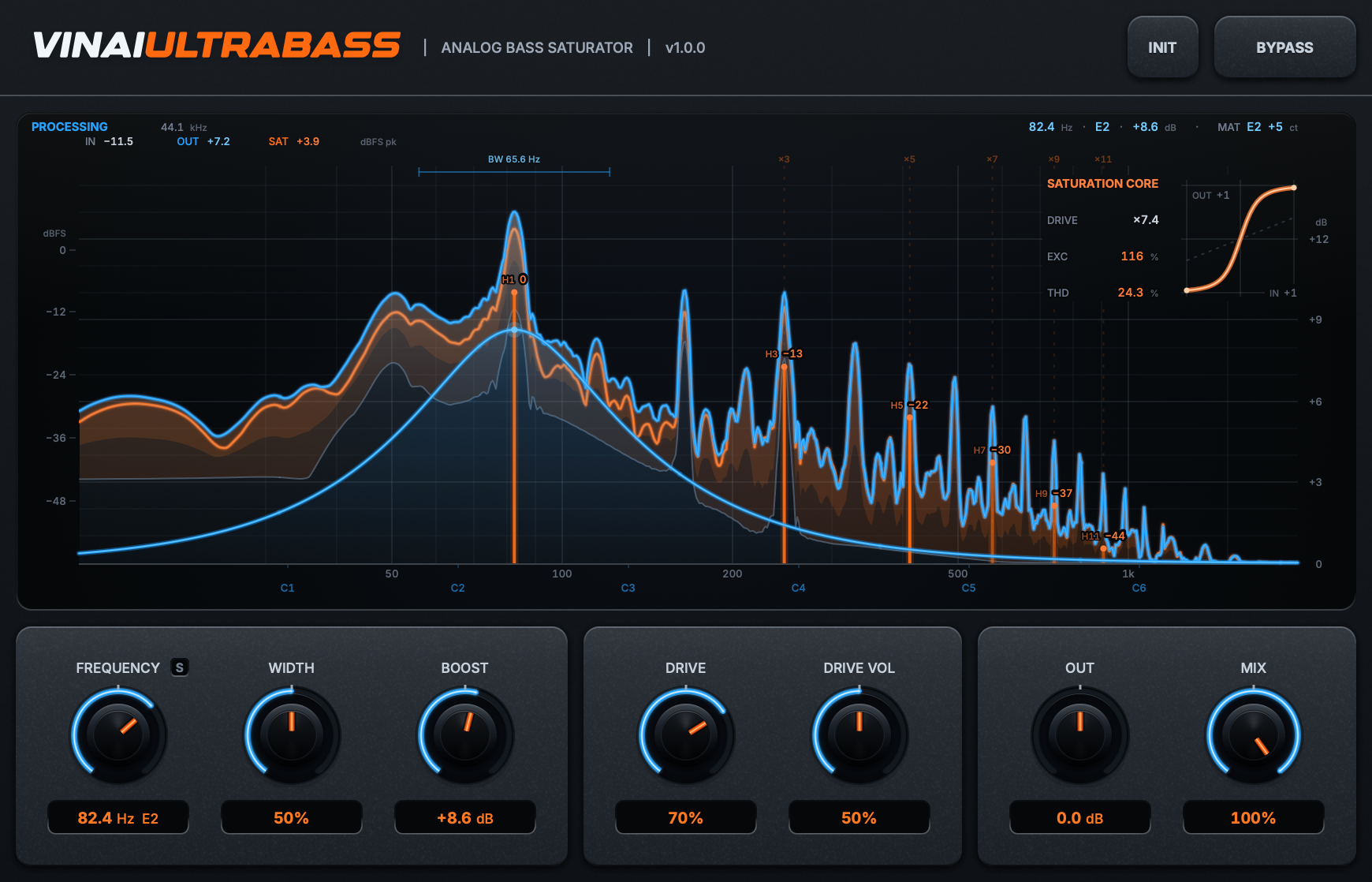
- Lab-grade analyzer: one plot across the full width. Measured IN, OUT and SAT traces read against a dBFS ruler and the blue bell response against its own dB ruler, over Hz and note rulers, with a −3 dB bandwidth caliper (BW). Every generated harmonic (H3 / H5 / H7…) is pinned at its true frequency with its level in dBc, and a fixed readout in the header shows the exact Hz · note · dB of the boost, plus the pitch of the incoming material (MAT) and how many cents it sits from the bell.
- Saturation Core (top right of the plot): the clipper's live transfer curve at the current drive, with DRIVE, EXC (how far the signal swings into the clipper, measured) and THD readouts.
- Frequency readout: the targeted frequency in Hz and the nearest musical note, with FREQ SNAP to lock to that note.
- Bell controls: FREQUENCY, WIDTH and BOOST shape the resonant low-end lift; BOOST reads in dB, the actual bell peak gain.
- Drive controls: DRIVE and DRIVE VOL push and blend the parallel odd-harmonic path.
- Output controls: OUT and MIX, with INIT and BYPASS in the top bar.
03Knobs & buttons
Bell & saturation
Frequency
Centre of the peaking bell, 14.6–240 Hz. Readout shows both the exact Hz and the nearest musical note
Freq Snap
Quantizes Frequency to the nearest note so the boost locks to the key of the track
Width
Bell Q: narrow for surgical resonance, wide for a broad foundation lift
Boost
Gain of the bell for transparent resonant low-end weight, up to +12 dB. Reads in dB: the actual bell peak gain, independent from Width, the same number the header readout shows
Drive
Push into the parallel odd-harmonic soft-clipper to generate H3 / H5 / H7 content
Drive Vol
Blends how much of the saturated harmonic path reaches the output
Output & utility
Out
Final output level, ±12 dB
Mix
Global dry / wet, 0–100%, with bit-exact dry at 0%
Init
Resets every knob to its default starting point; BYPASS and FREQ SNAP stay as they are
Bypass
Bypasses the processing for a clean A/B against the source
04The Adaptive Harmonic Core
The engine runs two stages in parallel rather than in series, so each does one job cleanly. The bell adds resonant weight exactly where you point it; the odd-harmonic path rebuilds the translation harmonics on top. Because they're independent, you can run either alone or blend the two:
- Clean boost: bell only. Transparent resonant weight from 14.6–240 Hz with no added harmonics, for pure surgical low end.
- Harmonic drive: push DRIVE and raise DRIVE VOL so odd harmonics bloom on top of the sub and the bass cuts through on small speakers.
- Note lock: FREQ SNAP quantizes the bell to the nearest musical note, locking the boost to the key of the song.
The analyzer draws the bell response and pins the generated harmonics as you work, the Saturation Core in the corner of the plot tracks the clipper's transfer curve and THD in real time, and per-sample smoothing on DRIVE, DRIVE VOL, OUT and MIX keeps those moves zipper-free no matter how fast you ride them.
05Under the hood
Two paths run in parallel and sum at the output: a clean resonant boost and a harmonic generator. Neither is in series, so the bell never feeds the clipper and the clipper never colours the clean lift. Each carries exactly one job.
Signal flow
Input splits into a boost path and a harmonic path. The boost path is a single peaking-EQ biquad. The harmonic path takes a band-passed copy, drives it through an odd-symmetric soft-clipper, and is scaled by DRIVE VOL. The two are summed, trimmed by OUT, then blended against the unprocessed dry signal by MIX.
- Boost biquad: a double-precision RBJ peaking-EQ section in transposed direct-form II. Double precision keeps the coefficients well-conditioned at sub-bass centre frequencies where single-precision biquads drift and lose denominator resolution.
- Harmonic path: a parallel band-pass feeds an odd-symmetric algebraic soft-clip,
x / (1+|x|n)1/n. The odd symmetry means a pure tone comes out with only odd harmonics added (H3 / H5 / H7…), the partials the ear uses to reconstruct a missing fundamental. The clipped path is blended back in at the output. - Parameter mapping: FREQUENCY, WIDTH (Q) and BOOST (gain) are not raw knob curves. They're driven from measurement-fitted mappings (a 21-point Hz table for frequency, a log-scaled curve for Q, and a measurement-derived gain curve capped at exactly +12 dB), so the on-screen number and the actual bell response agree across the whole 14.6–240 Hz range.
- Smoothing: DRIVE, DRIVE VOL and OUT are smoothed per sample with roughly a 4 ms time constant, and MIX glides on a 20 ms linear ramp that lands exactly on its target, so fast moves and automation on those controls stay free of zipper noise.
- Dry path: at MIX = 0% the wet sum is fully muted and the dry signal passes bit-exact; no biquad state, summing, or trim touches the samples on the dry leg.
- Latency: the chain is entirely biquad + memoryless waveshaping, with no oversampling, FFT or lookahead, so it reports and adds zero latency. No delay compensation is required from the host.
- Metering: the pipeline runs decoupled from the audio thread. The IN, OUT and SAT traces are FFT measurements of the input, the output and the drive path as it reaches the output; the bell curve is computed from the current biquad coefficients, and the harmonic pins, transfer curve and THD readout are derived from the same drive mapping the engine runs on, so the GUI reflects the running DSP state without touching the processing path.
06Measured
Measured in-house (headless host + numpy/scipy), 48 kHz.
| Latency | 0 ms / 0 samples, zero-latency |
| Bypass | Bit-exact: nulls to the measurement floor |
| Magnitude flatness | ±0.01 dB, 20 Hz–20 kHz (neutral path) |
| Self-noise | None (silence in, silence out) |
| Sample rate tested | 48 kHz |
07Specifications
| Type | Harmonic bass enhancer: parametric bell + parallel odd-harmonic saturation (Adaptive Harmonic Core) |
| Frequency | 14.6–240 Hz · shown in Hz + nearest note · FREQ SNAP to note |
| Boost | Reads in dB, the actual bell peak gain · up to +12 dB · independent from Width |
| Drive | Push into the parallel odd-harmonic soft-clipper |
| Drive Vol | Blend level of the saturated / harmonic path |
| Output | ±12 dB |
| Mix | 0–100% dry / wet · bit-exact dry at 0% |
| Display | Lab-grade analyzer: measured IN / OUT / SAT traces · dBFS/dB/Hz/note rulers · harmonic pins in dBc + peak readout · Saturation Core (transfer curve, drive, excursion, THD) |
| Formats | VST3 · AU |
| Systems | macOS 12+ (Universal) · Windows 10+ · 64-bit |
| Version | 1.0.0 |